Environmental Design · Syeh Sazane Mehr Gostar · 2009–2010
A large-span curved ACP canopy for a car wash and petrol station complex on Dadman Street, west Tehran — won through open competition and built on site over a six-month development cycle.
01 — Project Overview
The Farahzadi car wash complex on Dadman Street in west Tehran already had an awning — a large-span fabric canopy installed by another company. It failed regularly. In any wind, even light, the structure would heave up and down, threatening safety and projecting an image of impermanence entirely at odds with the established Star Wash / Best Wash brand.
The designer was commissioned by Syeh Sazane Mehr Gostar to compete for the replacement canopy design. After winning the competition among several submitted proposals, the designer led the structure through full dimension documentation and supervised its manufacture and installation. From first site visit to final build: six months.
"Every design decision came from one clear issue. The previous canopy failed because it could not resist wind. That problem shaped everything, from the structural system to the material choices."
02 — The Problem
Before this project, the car wash forecourt was sheltered by a fabric membrane canopy — a common and economical solution for commercial forecourts in Iran. The designer visited the site in multiple weather conditions before proposing any design, observing the behaviour of the structure under wind loads in real time.
The diagnosis was structural, not cosmetic. Fabric canopies at this scale fail in wind because they lack both rigid plane stiffness and sufficient anchoring tension — the membrane flexes and flaps, which amplifies load rather than shedding it. The height of the columns was also a compounding factor: taller columns mean a longer lever arm for any lateral wind pressure, producing greater oscillation at the canopy edge.
03 — Design Process
04 — Structural Concept
The structural concept is derived from bridge engineering — specifically the cable-stayed bridge, where a central mast under compression carries tension rods that support a horizontal deck. Applied to the canopy, the mast rises above the roof plane and the cables tie the outer canopy edge back to the mast head. This converts what would be a bending problem (wind trying to lift the canopy edge) into a pure tension problem in the cable — which steel handles with great efficiency.
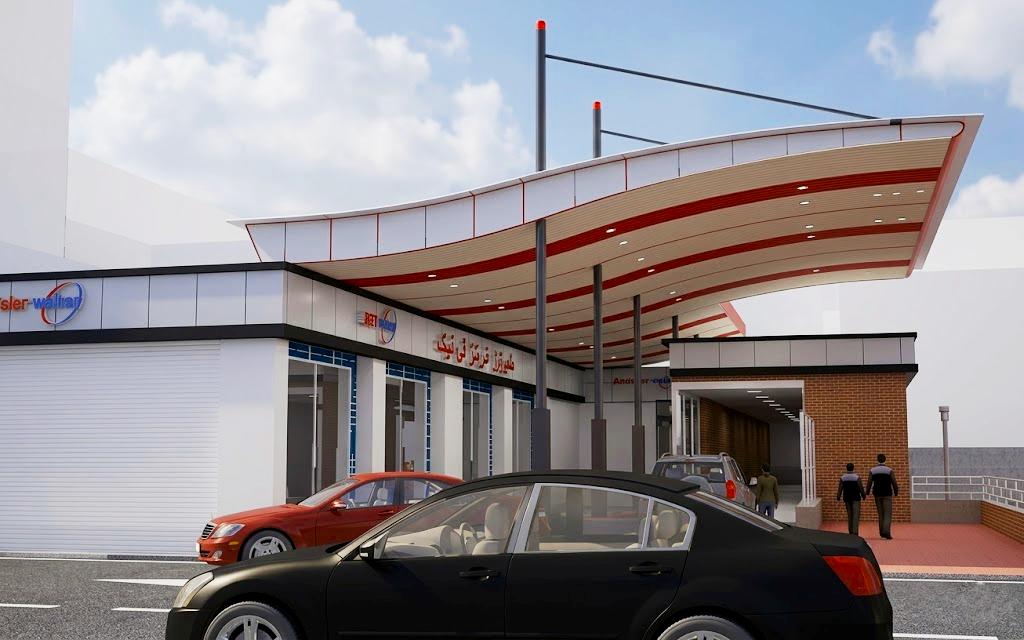
The canopy surface is a single long curve spanning 14 metres — high at the building wall (7.5 m to mast tip, 4.5 m clear vehicle clearance at the low mid-point) and tapering to 1.9 m at the far edge. This asymmetric section profile sheds rainwater outward while maintaining generous clearance for vehicles beneath.
The curved truss was built from structural steel with 75 cm panel bays. Each bay carries one ACP panel on the soffit face — white with the red accent stripe running longitudinally, referencing the car wash brand identity painted on the building behind.
Structural concept — mast, cable stay, and curved truss with ACP soffit. Wind uplift resolved by cable tension, not membrane stiffness.

Competition drawing — section elevation, selected concept

Competition drawing — front elevation with human & vehicle scale
05 — Design Development
The early design studies explored two formally distinct structural families. Both are shown as SketchUp models produced during the competition phase. The tree-column concept used branching curved steel arms, each rising from a single ground point and splitting to support a polycarbonate roofing sheet — referencing organic and traditional Persian arch structures. However, each branching joint introduced fabrication complexity and potential failure points. The cable-stay truss was more direct, more buildable, and structurally superior under wind.
"The tree-column concept was visually rich — but it multiplied fabrication points and foundation requirements. The cable-stay truss solved the same problem with less material and greater wind stiffness. The simpler solution was the better one."

Study model A — tree-column concept, front view

Study model A — tree-column concept, rear perspective

Final competition render — approved cable-stay design

Final render — building context view
06 — Built Outcome
The finished canopy replaced the fabric structure entirely. The photographs show the structure at installation — during ACP panel fitting with the Alborz mountains visible behind — and after completion at the car wash forecourt, shot from below, from the street, and in detail of the soffit cladding.
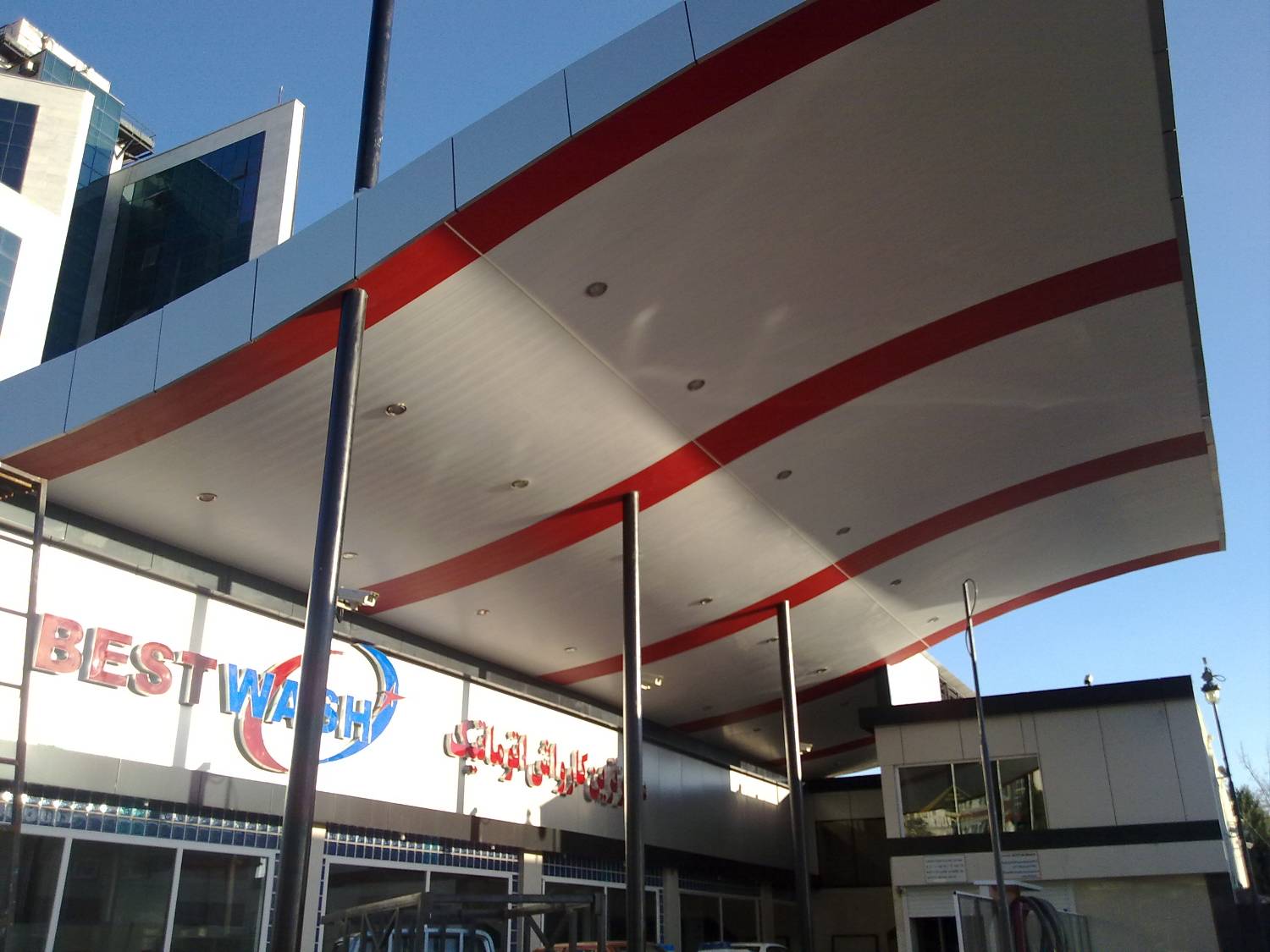
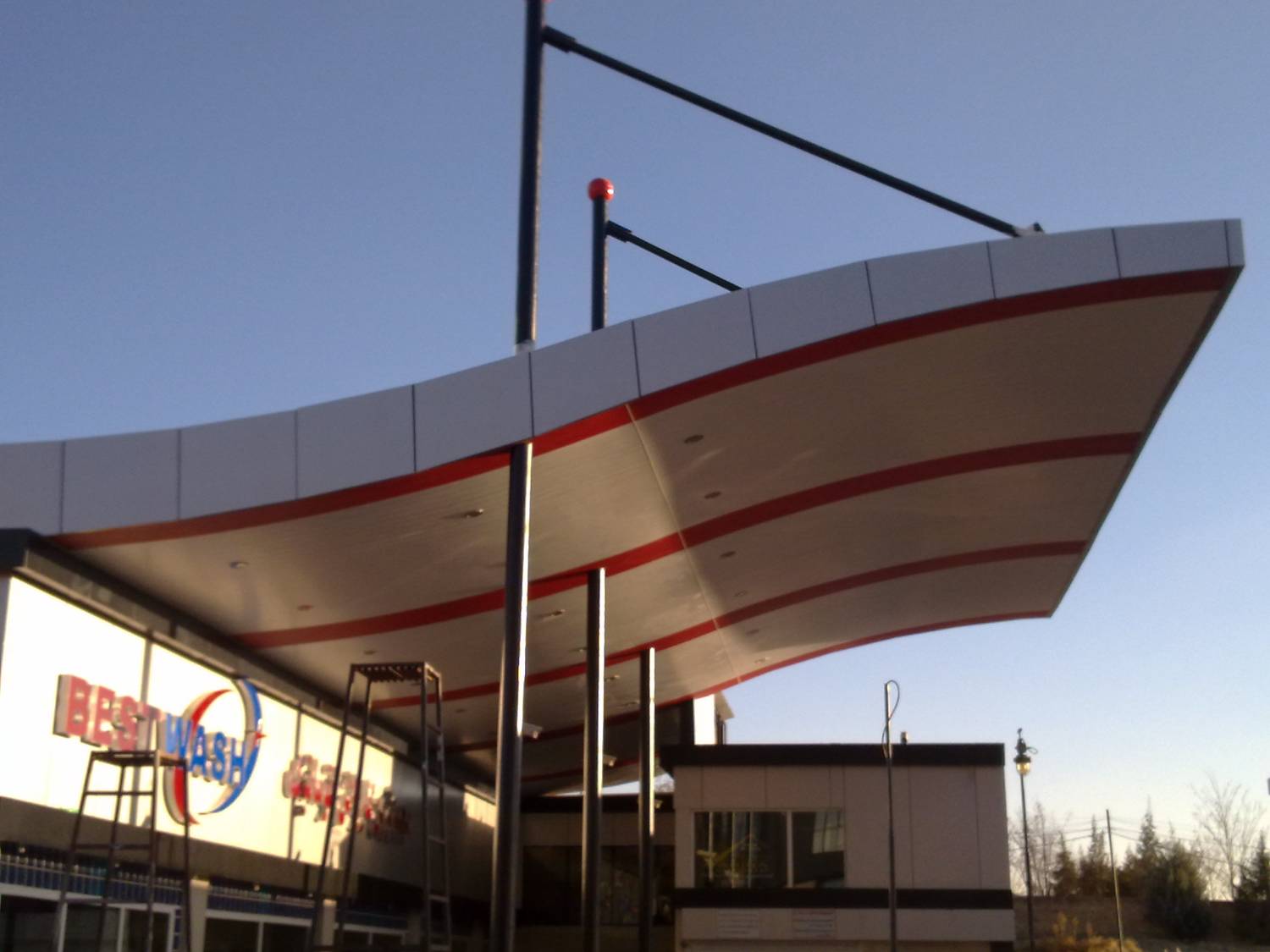
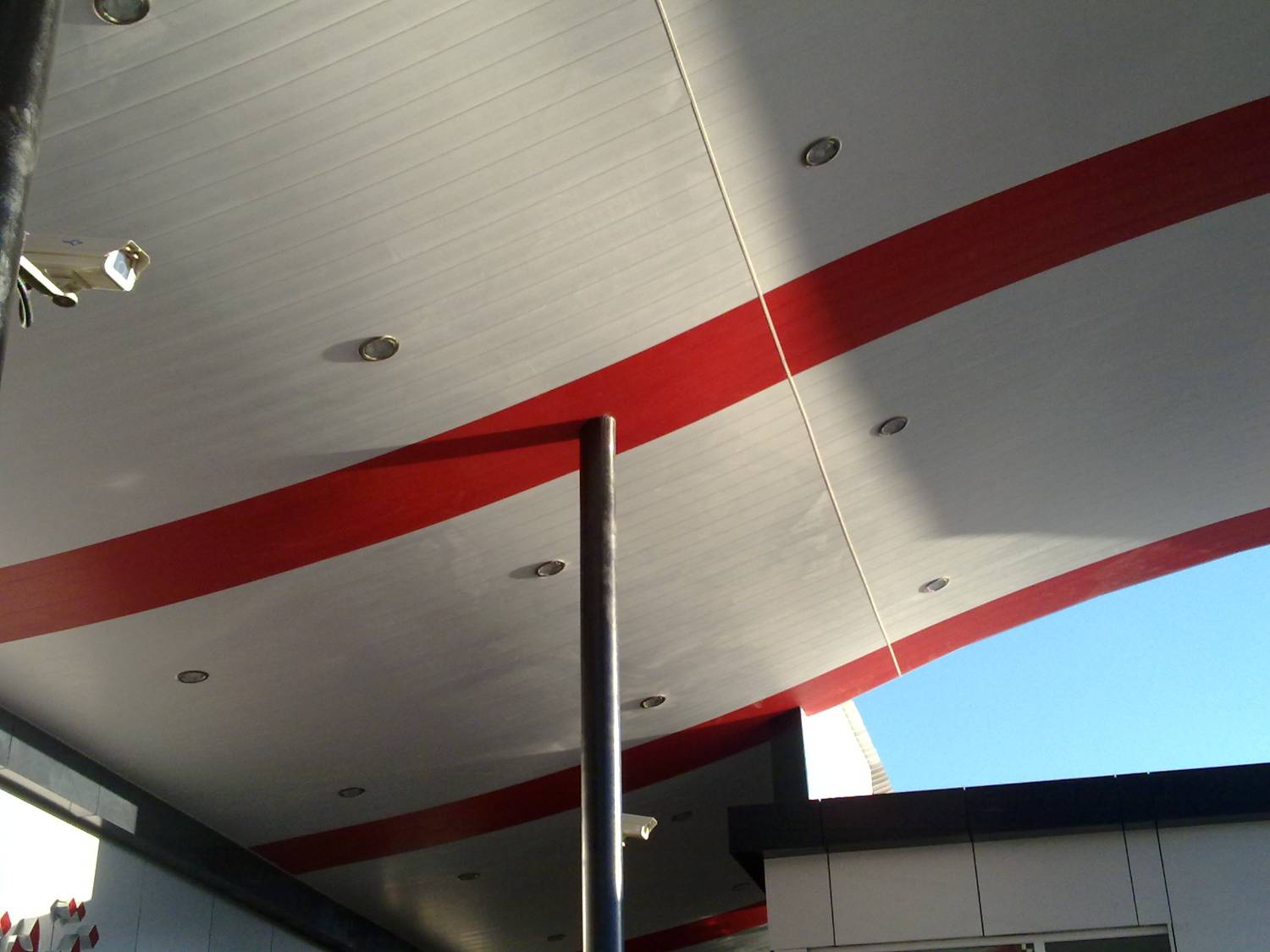
Built canopy — soffit view, exterior, and cable stay detail (Dadman Street, Tehran)
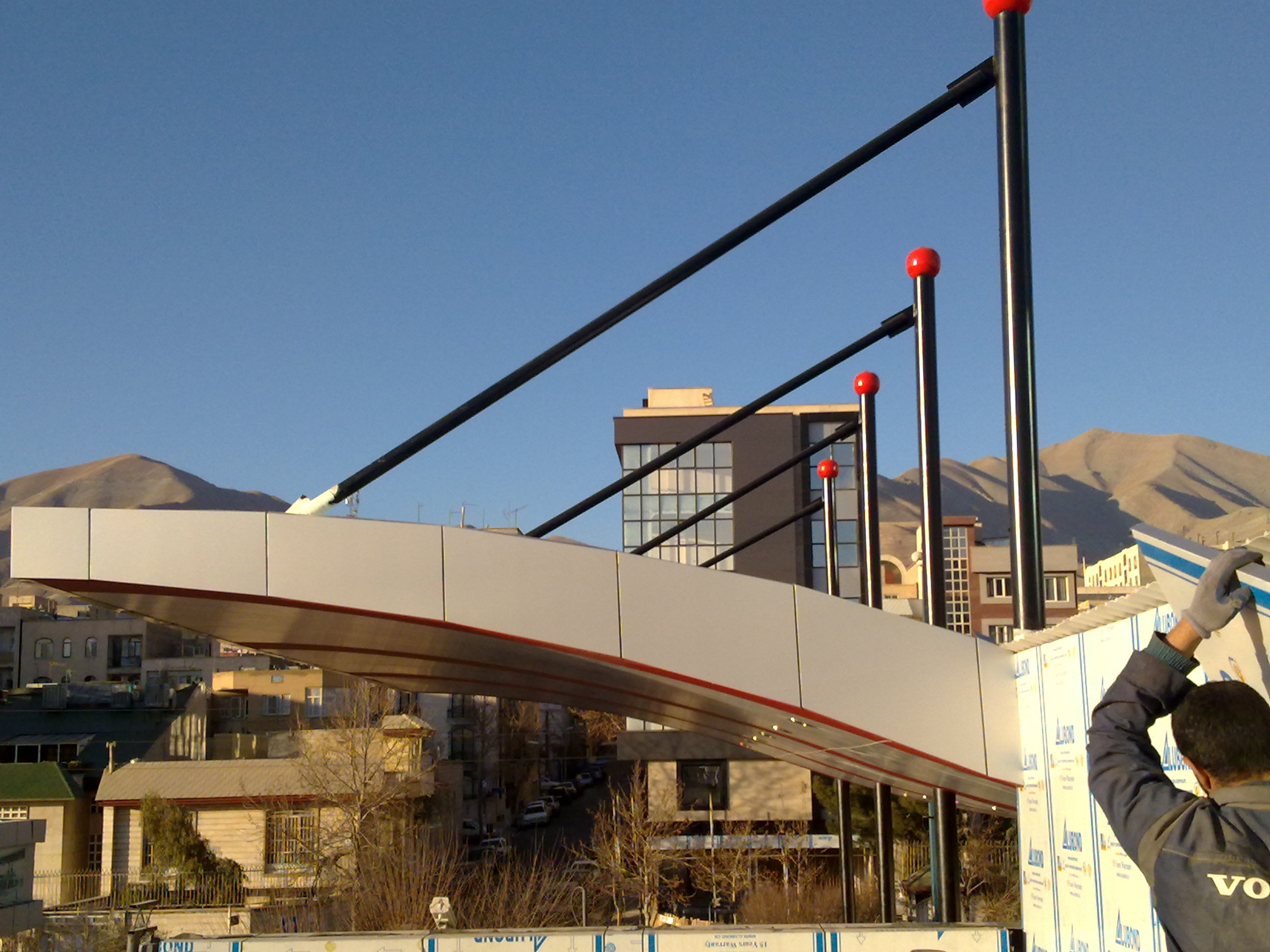
Installation phase — ACP panel fitting in progress, Dadman Street
07 — Material
The soffit cladding material — referred to locally in Iran as "composite" — is Aluminium Composite Panel (ACP), a sandwich construction of two thin aluminium sheet faces bonded to a rigid polyethylene core. International brand names include Alucobond, Alpolic, and Dibond, though equivalent products are manufactured domestically in Iran.
ACP was the correct material for this application for several reasons: it is lightweight (critical for a canopy where dead load increases demand on the cable stay system); it is rigid in-plane (each 75 cm panel tile, once fixed to the truss, contributes to overall surface stiffness); it is weatherproof without painting; and it is available in any colour — allowing the white body and red accent stripe to match the ACM cladding on the car wash building façade exactly, producing the visual continuity the client required.
08 — Role & Authorship
This project is unusual in a designer's portfolio because it begins with a competition win. The design was not assigned — it was selected from among competing proposals submitted by multiple firms. That selection validates the concept as the strongest submitted answer to the client's problem.
The designer's role encompassed the full project arc: site observation and problem diagnosis, structural concept development and iteration (including the rejected tree-column alternative), competition drawing preparation, dimension documentation after award, and liaison with the civil engineering team during structural calculation and fabrication. The physical structure standing on Dadman Street is the direct built consequence of the designer's concept.
09 — Outcome & Reflection
The completed canopy resolved every failure mode of its predecessor. The rigid ACP-clad curved truss does not flex or flap in wind. The cable stay system converts uplift force to pure tension in the rods — a load path that steel handles simply and reliably. The recessed soffit lighting and the red-stripe ACP banding translate the car wash's brand identity upward into the canopy, making it a piece of commercial identity as much as a piece of infrastructure.
The competition win demonstrates the strength of the design approach: diagnosing the root cause first, proposing a concept that directly addresses that cause, and communicating it visually well enough to persuade a client who had other options.